

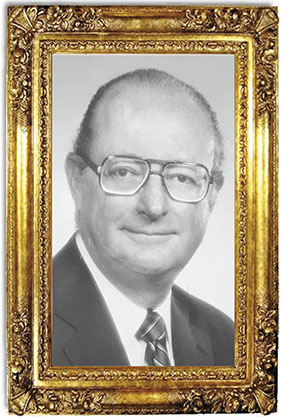


Richard J.V. Johnson
The Houston Chronicle
Hall of Fame Class of 2024
Dick Johnson was one of those rare individuals who rose through the ranks of one newspaper and reached the pinnacle of his profession as chairman and publisher of one of Texas’ leading newspapers, the Houston Chronicle. Along the way he also achieved great success in developing his community and serving the people of the Houston Metropolitan Area.
Johnson was born in San Potosi, Mexico in 1930. His family returned to the states in 1937 and moved to Houston in 1941. To help support his mother and his siblings Johnson ran a Chronicle paper route.
After graduation, Johnson enrolled at Texas A&M University and played basketball for the Aggies. After a year he transferred to the University of Texas at Austin, where he graduated with a degree in business administration in 1952.
After serving two years in the Army, he accepted a job with the Texas Daily Newspaper Association doing market research and anything else TDNA Director John Murphy threw his way. At that time the TDNA offices were in the Chronicle Building.
Fate took a hand in Johnson’s life in 1956. His wife, Belle, was expecting their first child. He went to John Murphy and told him he needed a raise with the coming addition to the family. Murphy didn’t have the budget and told him no. Disheartened, he left the office for lunch and happened to get on the elevator with Jack Butler, the Chronicle’s general manager. Butler had heard of Johnson. During the elevator ride, he told the younger man to come see him if he ever thought about changing jobs. Johnson simply replied, “How about 2:00 today?”
His first job at the Chronicle was as a copywriter in the promotions department. He would eventually progress to the head of the department. He held seven different jobs at the Chronicle before being named president in 1973. He was named publisher in 1983 and assumed the role of chairman and publisher in 1990.
Johnson spent his entire newspaper career at the Chronicle and helped usher in cold type, offset printing and other technological advances all in the same building at 601 Texas Avenue.
Johnson was at the helm when Houston Endowment, the parent of the Chronicle, was required to sell the newspaper. Expecting to get $200 million or so, the bidding ran up until the Hearst Corporation paid $445 million for the paper — all because of the value Johnson had helped create.
Hearst wisely kept him on staff.
He led the conversion of the Chronicle to a morning newspaper so successfully in competing with the rival morning Post that the Post eventually sold its assets to the Chronicle, which took up residence in the Post’s headquarters on the Southwest Freeway. Johnson retired from the Chronicle in 2002.
He passed away in 2006.
During his career he served as president of the Texas Daily Newspaper Association and president of the American Newspaper Publishers Association. He received the Pat Taggert Newspaper Leader of the Year Award from TDNA. He supported dozens of local institutions, including the Houston Food Bank, the University of Texas M.D. Anderson Cancer Center, the Houston Grand Opera and the Museum of Fine Arts, Houston.
Johnson helped start the Houston READ Commission, dedicated to erasing illiteracy.
He supported the United Way of the Texas Gulf Coast, and when he served as a campaign chairman the organization raised $61 million. Johnson even donated property he owned to the city of Houston and Habitat for Humanity in the 1990s.
Perhaps his greatest role outside the Chronicle was his chairmanship of the world-famous Texas Medical Center. His service was honored when the city named a street at the ever-growing center Richard J.V. Johnson Avenue.
President George W. Bush summed up Johnson’s life when he said no one had done more for the City of Houston than Dick Johnson.